

Lyon Lip Ruler
Measuring Smile Line and Incisal Display for Full-Arch Implants
A simple, sterilizable ruler that rests on the incisal edge so you can measure incisal display and the high smile line in seconds, then use the same tool in sergyer to plan FP3 bone reduction.
One steady number for the smile line, chairside, & in surgery
The Lyon Lip Ruler is a small, 3D-printed measuring tool we designed in-house at Lyon Dental Implants & Oral Surgery. It rests on the incisal edge of a central incisor and reads incisal display and the high smile line directly off a millimeter scale.
We use it to measure how much tooth and gum a patient shows when they fully smile. Then we bring the same tool into surgery to mark the bone reduction for full-arch FP3 cases, so the prosthesis-to-gum transition stays hidden when the patient animates.
We built it because the usual tools made a simple measurement hard to take and harder to repeat.
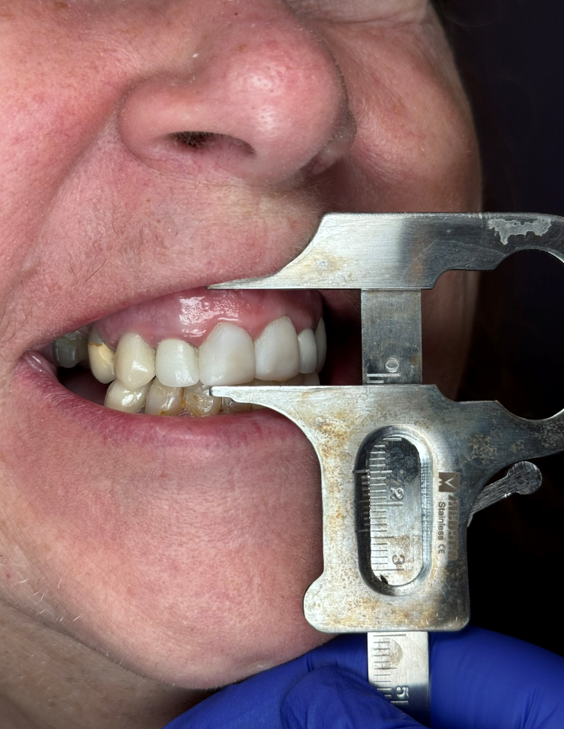
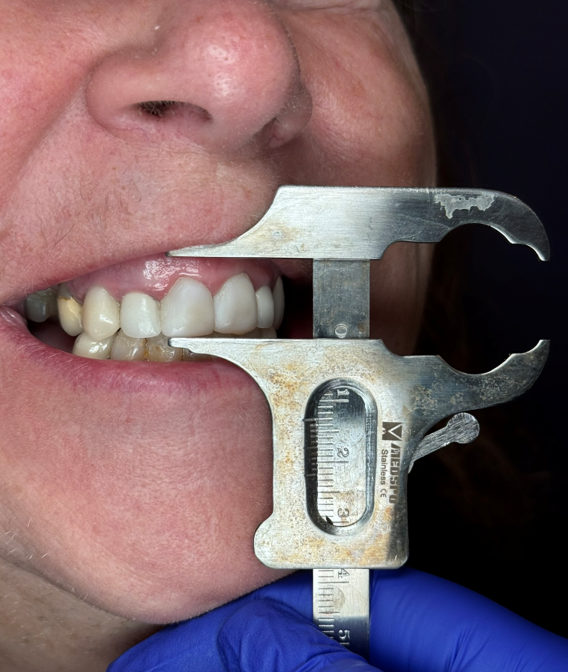
Same patient, same smile, two frames, two different readings. The gauge is also lifting the upper lip, so the lip is no longer where it naturally sits.
Those two photos show both problems. The number changes from frame to frame because the measurement is dynamic, and we want one steady, repeatable number. And any tool that pushes on the lip changes the lip position we are trying to measure.
Why measuring a smile is harder than it looks
To plan a full-arch case, we need one number: how high the upper lip rises at a full smile, measured from the incisal edge. Getting that number reliably takes four things to line up at the same moment.
The clinician holds a perio probe against the tooth with no hand rest, so it drifts.
The patient holds a maximum Duchenne smile, saying "EEEE" and showing their gums. That is a hard position to hold still.
The photographer has to catch the shot at the right angle while the probe and the lip are both moving.
The reading has to be taken from that photo, at that instant.
A Boley gauge is even harder. It needs two hands, it has no fixed rest on the tooth, and its jaw sits on the lip itself.
Why we use the Lyon Lip Ruler
The ruler turns a four-person balancing act into one steady reading.
It rests on the tooth, not your hand. A small seat on the back of the ruler cradles the incisal edge of the central incisor. That seat is the zero line, so the reference never drifts.
One steady number. With the ruler parked on the tooth, the patient smiles, the lip settles, and the number reads straight off the scale. The photographer gets a clean shot without chasing a moving probe.
It doesn't prop the lip. The part that goes under the lip is a thin, flexible strip, so the lip sits where it naturally would.
The same tool chairside and in surgery. We measure and photograph with it at the consult, then use the same ruler on the same tooth during surgery. Same reference, same scale, same number.
Mark the bone right at the line. A slot down the middle of the scale lets us mark the bone with a pencil exactly at the planned millimeter, with no guessing from the side.
Sterilizable. It is printed in surgical guide resin and sterilized like our other surgical guides.
It also measures incisal display at rest. The same setup reads how much tooth shows with the lips relaxed.
Two sizes. A 15 mm version for patients with a short vestibule or short crowns, and a 20 mm version for everyone else.
How we use it chairside
The whole measurement takes under a minute.
Pick the size. Use the 20 mm ruler for most patients. Use the 15 mm ruler for a short vestibule or short crowns.
Choose one reference tooth and write it down. We use a maxillary central incisor, and we use that same tooth again in surgery.
Seat the incisal edge in the rest. The tooth's incisal edge drops into the seat on the back of the ruler. That is your zero.
Tip the ruler against the alveolus. Let the thin upper part lie gently against the gum and bone, the way it will lie on the bone in surgery. Don't push the lip out or lift it.
Read incisal display at rest. With the lips relaxed, read where the upper lip crosses the scale.
Read the high smile line. Have the patient give a full Duchenne smile ("EEEE"). Read where the upper lip crosses the scale at its highest point.
Photograph it. Shoot straight on at the level of the incisal edge, with the camera square to the ruler, so the scale reads true in the photo.
Chart it. Record the tooth, the ruler size, the rest reading and the smile reading.
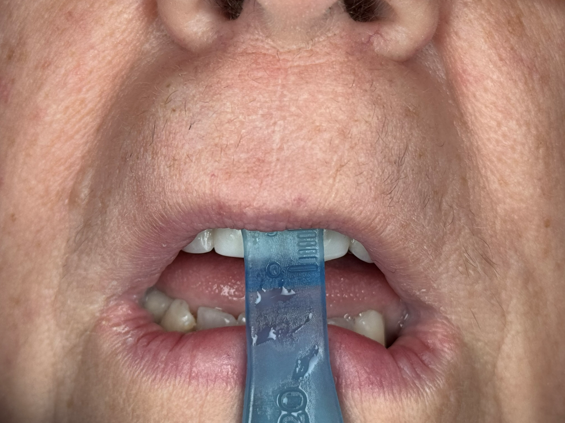
Seated on the central incisor with the lips at rest. Incisal display reads directly off the scale.
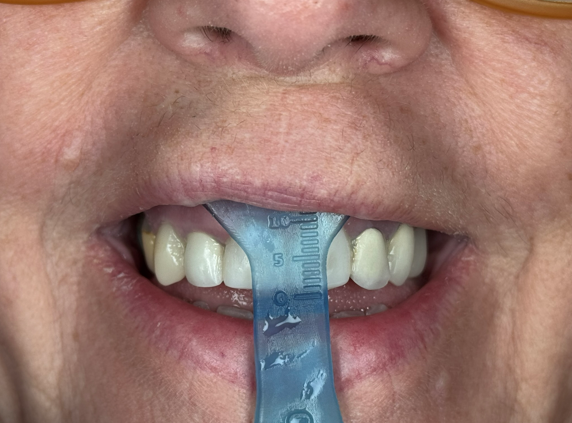
Full smile. The ruler stays parked on the tooth, the lip isn't lifted, and the smile line reads at 11 mm.
Tips for a reliable reading
Same tooth, same ruler, every time. Consistency is the whole point.
Tip it against the alveolus. That matches how it sits on bone in surgery and keeps the lip in its natural position.
Never let the ruler lift the lip. If the lip moves when you seat it, reseat it.
Coach the smile. A true Duchenne smile shows the most gum. Have the patient repeat it two or three times and take the highest steady reading.
Watch the reference tooth. If the central is extruded, flared, worn or mobile, its incisal edge may not be where the new prosthesis's incisal edge will be. Adjust the target for the planned incisal edge position.
Check restorative space too. The bone target should also give the lab the vertical space the prosthesis needs. Confirm both numbers with your restorative plan.
Shoot square. A camera angled up or down makes the scale read wrong in the photo.
Design at a glance
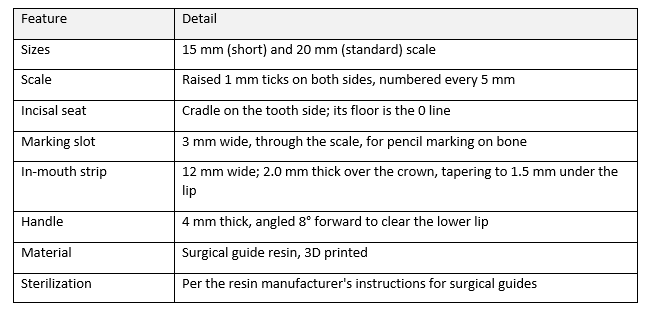
Get the Lyon Lip Ruler
Want one for your office?
The Lyon Lip Ruler is free for clinicians. Download the print files, print it in your own surgical guide resin, and use it on your next full-arch case.
STL - 15 mm
STL - 20 mm)
If you post it or present it, please credit Lyon Lip Ruler, designed by Anish Gupta, Lyon Dental Implants & Oral Surgery and tag us. We'd love to see your cases. @lyondentalimplants
Disclaimer: The Lyon Lip Ruler is shared for educational use by licensed clinicians. It is not a commercial medical device. Each clinician is responsible for printing, cleaning and sterilizing it according to their resin manufacturer's instructions, and for their own clinical judgment.